Christmas with the Kids

It happens every year, but it's different with kids.  We do things we might not otherwise do, like going to see "The Nutcracker".

I took Jade last year and we both really enjoyed it.  This year, Fawn and Halia came along.  We were worried that sitting still through the performance would be too difficult for an active three-year-old girl, but we were wrong.  She watched with rapt attention.

They both liked it so much that they wanted to watch the VHS version as soon as we got home.  It helps that they do an excellent job of it here in Whitehorse.


We also went to a Christmas concert at a local school, where the Grade 1s were playing Fawn's Christmas  song, "Angels Are Smiling".  It was soooooooooooooooooo cute seeing them sing the song (with cue cards to help them along) and they did an excellent job.  Jade and Halia enjoyed the performance, too.


Do they look really grown up in that previous picture?  I thought so, too, so naturally I put them to work.


Just kidding.  They're both playing on their favourite (shhhhh-they're-learning-how-to-read-but-don't-tell-them) website, Starfall.com.  And just to prove that it's not all work, here are some pictures from us at play.


Aww, what a cute kitty!


Bad kitty!  Get out of that banjo case!  (Yes, just in case you were wondering, our cat, Crook, is still alive.)


Our friend, Nita, dropped by with some presents for the girls.  She made one gorgeous quilt for Jade and another gorgeous quilt for Halia.  They love them.  Thanks, Nita!!!


The same night that Nita dropped by with the quilts, we took the girls out for a little bit of Christmas carolling with about 30-40 or our neighbours.  It has become a bit of an annual tradition here, but the first year that we were able to participate.


Right now, the girls are tucked snugly in their beds.  I'm sure it'll be happy mayhem in a half-dozen precious hours.

I hope that your Christmas is filled with happy mayhem, too.  Merry Christmas!

Some things don't need translation.

This is the last of the posts from my trip to Moscow and Siberia.  Although there are many, many differences between where I live and where I visited Russia, it's nice to know that there are many, many things we have in common.

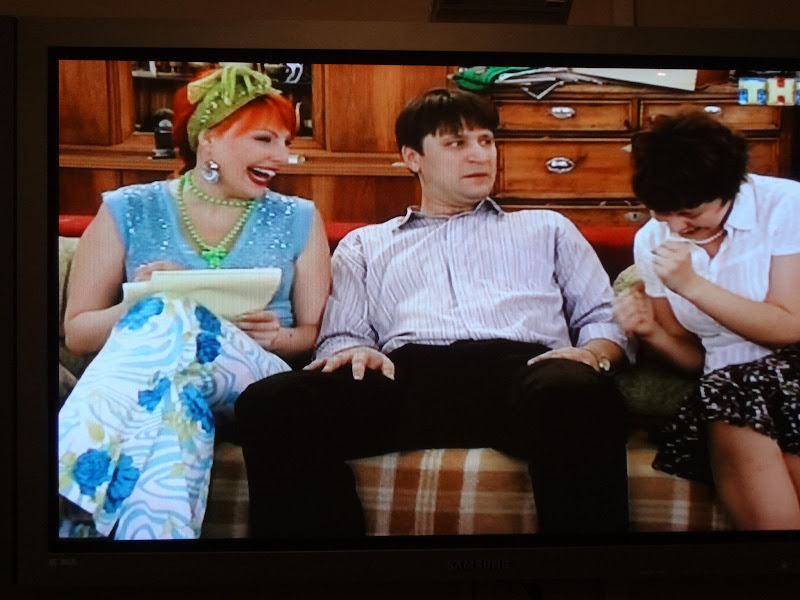
There was a television at the Krasnoyarsk airport. It was playing a program that was so very familiar to me that translation was not required.  It was playing a program that reminded me that people are basically the same everywhere.

Look familiar?
 
What about now?


You must recognize it by now!


The resemblance is uncanny.  The characters are nearly identical, with the same great comic timing. And even though they're speaking in Russian, their voices sound the same.  Want to see them in action?


Crazy.

In Russian, the translation of the show's title is "Happy Together".  Do you know what it is in English?

Just in case you were wondering...

Question: What is it like to eat at a Mexican restaurant in Russia?

  Answer: Even better than eating at a Mexican restaurant in Mexico.

The Krasnoyarsk Dam

Once the fifth largest hydro-electric dam in the world (now the 7th), the Krasnoyarsk dam was an impressive feat of engineering.  It supplies 6,000 MW of power.  In comparison, the Yukon has a teeeeeeny tiny generation capacity of about 139 MW.


Construction of the Krasnoyarsk dam started in 1956 and ended in 1972.  I'm not sure when this mosaic tile tribute to Lenin was built, but it's the first thing you see when entering the facility (other than the security gate and the dam itself which, I guess, doesn't make it the first thing, but one of the first things).


When the spillway is wide open, I'm told that water shoots hundreds of feet into the air.


For an industrial facility, there are some exceptional pieces of art.  This piece lines the wall of the hallway entrance.


This model of the area below the dam is tucked in the main turbine room.


The turbines are replaced from time-to-time.  Everything that goes into the dam is made in Russia.  This giant pit houses just one of the (I think eight) turbines.  It was such a strange feeling in the turbine house; I could feel some very low sound waves.  Not everyone on the tour was able to feel them, but several of us could.


In the picture below, the dam is on the right.  The concrete "pillars" are actually the penstocks for the dam.  The penstocks are tubes of decreasing diameter that carry the water to the turbines.  The decreasing diameter pressurizes the water.  It's the highly-pressurized water that turns the turbines.


We got to go into the dam, under the penstocks.  It was hard to believe that we were just feet away from the bottom of a giant lake.  I asked if the dam is rated for earthquakes.  I was told that the dam was engineered to last 300 years and, based on the rating for which it's earthquake-rated, let's just say that it's where I'd like to be in the event of a major seismic event.


And this is the phone I would use to call for help, I think.


This funky piece of art is actually a map of how the system is/was supposed to look when it's compete.


I was glad we got to go up onto the dam.  It gave me a much better feel for just how massive it is.

Unfortunately, we ran out of time and didn't get to see the inclined rail that's used to lift boats from the river to the lake (and back).  We ran out of time because we had to get back to the airport.


We took one more quick trip back through town and before you could say "do svidaniya" we were on a flight for Moscow.

Krasnoyarsk Road Trip!

We got to go on a tour of the 7th largest (formerly 5th largest) hydro-electric dam in the world! The dam is featured on the 10 Rouble note. This post isn't about the dam, though. It's about the drive there.


View Larger Map

We crossed from the north side of the Yenisei River (the largest river system that drains into the Arctic Ocean) to the south side of the river over the Soviet People's Bridge.  I believe that, locally, they're referred to as the West and East Side.
 

The city was once divided into two parts.  During times of conflict, the interior of Russia was seen as a safer place to move manufacturing.  The south (east) side of the river was once a manufacturing centre.  It is now becoming more of a residential area.


Look! The Trans-Siberian Railroad!


There were lots of the great old wooden houses.  I don't know if they're cold and uncomfortable or warm and cozy, but there certainly are a lot of them!


They have a permanent carnival!  It's closed for the season, but still!


We stopped at a lookout over the Yenisei River.  There was a wooden shack where you could buy boxes and other gifts made out of birch bark.


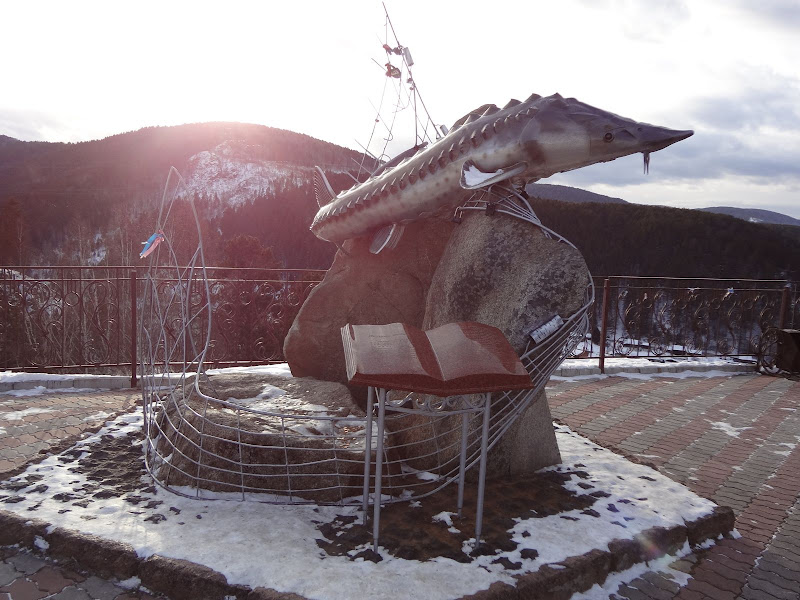
A sturgeon!

People had tied ribbons all around around the lookout.  If you look closely at the picture above, you'll see ribbons tied there, too.  According to our guide, this is done by the indigenous peoples at numerous significant sites as an offering of thanks.  I thought this was super-cool, because I know this was once practiced by indigenous peoples in Canada.  It is well-documented and stories are told of how the Dene tied ribbons and left offerings at significant sites like Louise Falls and Alexandra Falls on the Hay River in the NWT.  Some people still do this.

It was especially interesting to me because I had just watched a fascinating presentation by Colleen Henry of the Arctic Athabaskan Council about the language link between the Na-Dene languages of North America and the Kets language, which was once though to have no language relatives (at least in Asia).  They have demonstrated the connection with 120 similar words and a similar (and complex) language structure.  It is though that the languages became isolated from each other approximately 2,500 years ago.  You can read more about it here.


We continued to make our way upstream, past little villages and summer home communities, past planned villages comprised of apartment buildings, and by decaying industrial buildings.


And then we saw the dam.  Pictures for that will follow in the next entry.